Losing a tooth can change more than your smile. You may find yourself avoiding certain foods, feeling less comfortable speaking in public, or wondering whether the gap will affect your remaining teeth. If you have lost several teeth, the decision can feel even more complicated.
Two of the most common ways to replace missing teeth are dental implants and dentures. Both can restore the appearance of your smile and improve your ability to eat and speak, but they work differently. They also differ in cost, treatment time, maintenance, comfort and long-term effects on your oral health.
So, which option is right for you?
Dental implants may be a better fit if you want a fixed replacement and are suitable for implant surgery. Dentures may suit you better if you prefer a removable, non-surgical option or need to keep initial costs lower. If you are missing most or all of your teeth, implant-supported dentures may offer another option worth considering.
There is no single solution that works best for everyone. Your remaining teeth, gum health, jawbone condition, general health, budget and personal preferences all matter.
At Studio Dentale, patients can explore tooth replacement options with personalised treatment planning, including digitally planned implant care led by Dr. Nikita Agarwal, a prosthodontist and oral implantologist.
Dental Implants vs Dentures: What Is the Difference?
The main difference is how each option stays in place.
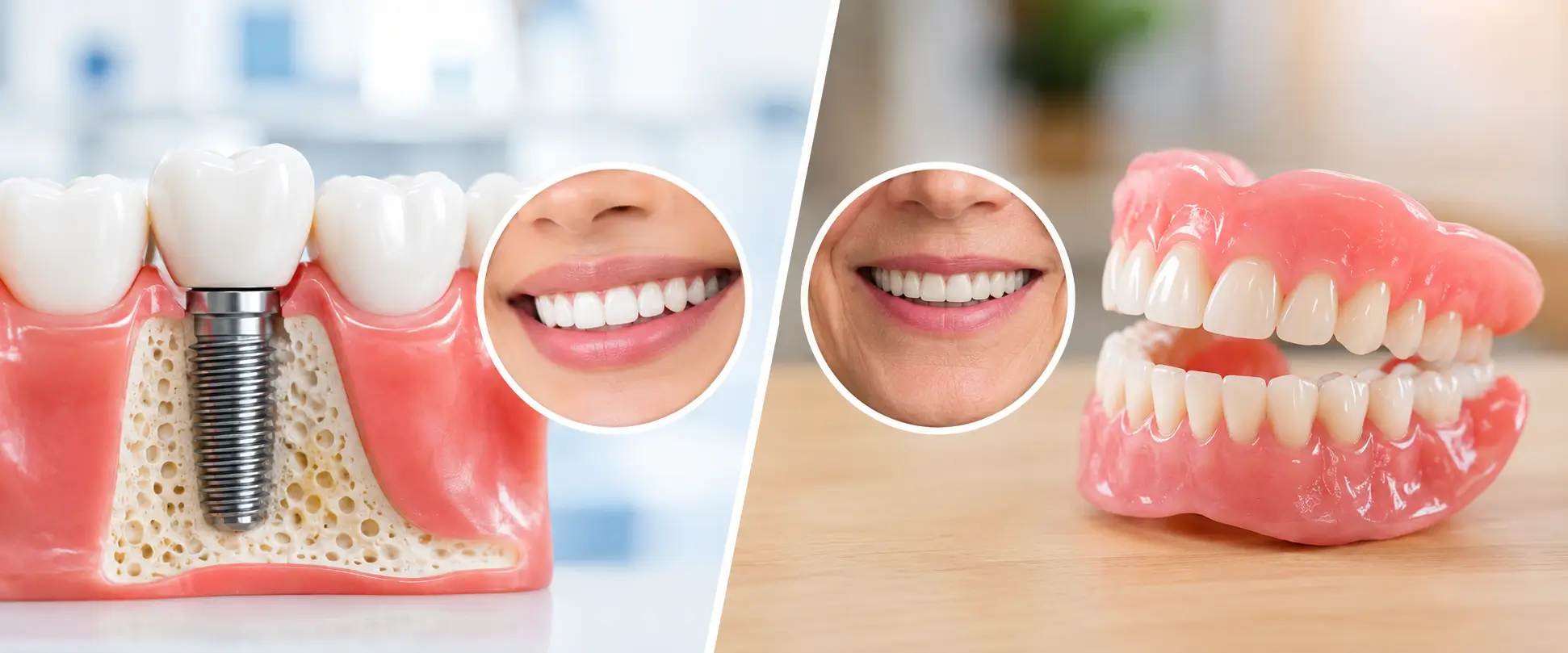
Dental implants are small posts, commonly made from titanium, that are surgically placed in the jawbone. After healing and integration with the bone, they support a replacement tooth, a bridge or a full-arch restoration. The implant acts as an artificial tooth root.
Dentures are custom-made replacement teeth that rest on the gums. Partial dentures replace some missing teeth, while complete dentures replace all the teeth in the upper or lower jaw. Conventional dentures can be removed for cleaning and do not require implant surgery.
Here is a quick comparison:
|
Factor |
Dental implants |
Conventional dentures |
|
How they stay in place |
Anchored in the jawbone |
Rest on the gums and may use suction, clasps or adhesive |
|
Removable? |
Usually fixed; some implant-supported restorations are removable |
Yes |
|
Surgery |
Required for implant placement |
Not required |
|
Initial cost |
Generally higher |
Generally lower |
|
Treatment time |
Usually longer because healing is required |
Often shorter, depending on the case |
|
Chewing and stability |
Usually offers strong stability once treatment is complete |
May move or feel less stable, particularly as the mouth changes |
|
Jawbone changes |
Helps maintain bone in the areas supported by implants |
Does not prevent the bone beneath the denture from shrinking |
|
Maintenance |
Daily cleaning and professional reviews |
Daily removal and cleaning, with adjustments as needed |
|
Long-term care |
The implant, gums and attached teeth need ongoing monitoring |
May require relining, repairs or replacement as the mouth changes |
Neither option is automatically the right choice simply because it is newer or more affordable. The important question is which one can meet your needs safely and reliably.
What Are the Benefits of Dental Implants?
Dental implants are designed to replace missing tooth roots as well as the visible teeth. For suitable patients, this can offer several advantages.
1. A Fixed Replacement That Feels More Secure
Once an implant has healed and the final restoration is fitted, it stays in place during everyday activities. You do not need to remove a conventional implant-supported crown or bridge for cleaning.
This fixed design can be especially helpful if you have struggled with a loose denture or worry about movement while eating or speaking.
Implants do not guarantee that every patient will experience exactly the same sensation as natural teeth. However, many patients value the stability they provide.
2. Support for Jawbone Health
Natural tooth roots transmit forces into the jawbone during chewing. When a tooth is lost, the bone in that area can gradually shrink because it no longer receives the same stimulation.
An implant can transmit chewing forces to the surrounding bone and help maintain the bone around the implant. It does not prevent all bone loss throughout the jaw, and it cannot restore every area of bone that has already been lost without additional treatment.
Conventional dentures sit on the gums, so they do not provide the same root-like stimulation. As the jawbone changes, a denture that once fitted well may become loose.
3. Replacement for One Tooth or Several Teeth
Dental implants are not limited to people who have lost all their teeth. Depending on your clinical situation, they can replace a single missing tooth, support a bridge for several missing teeth, or form part of a full-arch restoration.
For example, if you have lost one back tooth but the neighbouring teeth are healthy, an implant-supported crown may be an option that avoids preparing those neighbouring teeth for a conventional bridge.
If several teeth are missing, the dentist will assess the spacing, bone support and bite to determine whether individual implants, an implant-supported bridge or another approach is more suitable.
4. No Daily Removal for Fixed Implant Restorations
A conventional fixed implant crown is cleaned in the mouth with brushing and appropriate interdental cleaning. You do not take it out every night.
However, fixed does not mean maintenance-free. Plaque can accumulate around implants, and the surrounding gums can become inflamed. Regular professional reviews and careful cleaning are essential to reduce the risk of peri-implant disease, which affects the tissues supporting an implant.
5. A Long-Term Tooth Replacement Option
Dental implants can function for many years, sometimes decades, when treatment is successful and maintenance is consistent. Their lifespan depends on several factors, including bone and gum health, smoking, general health, oral hygiene, bite forces and regular dental care.
The implant itself and the crown attached to it are not the same thing. The crown, bridge or other restoration may wear, chip or need repair or replacement even when the implant remains stable.
For this reason, it is more accurate to think of implants as a long-term treatment option rather than a guarantee of a lifetime without further treatment.
What Are the Benefits of Dentures?
Dentures remain a useful and appropriate tooth replacement option for many people. They are not simply an alternative for patients who cannot afford implants.
1. Lower Initial Cost
Conventional dentures generally cost less upfront than implant treatment, especially when several or all teeth need replacing.
If your budget is limited, dentures can restore the appearance of your smile and improve chewing without the additional cost of implant surgery.
It is still worth considering the longer-term costs of adjustments, relining, repairs and replacement when comparing treatment plans.
2. No Implant Surgery
Dentures do not require a post to be placed in the jawbone. This can make them a suitable option for patients who prefer to avoid surgery or whose medical circumstances make implant treatment less suitable.
Some people may also need time to improve their gum health, review their medications or manage certain medical conditions before implant surgery can be considered.
Your dentist can explain whether conventional dentures, another restorative option or a later assessment for implants would make the most sense.
3. A More Direct Treatment Process
A conventional denture is made using measurements or impressions of your mouth, followed by fitting and adjustments. The process is often shorter than implant treatment because there is no need to wait for an implant to integrate with the jawbone.
The exact timeline depends on whether teeth need to be extracted, how the gums are healing and whether a temporary or immediate denture is planned.
4. Suitable for Partial or Complete Tooth Loss
A partial denture can replace several missing teeth while using the remaining teeth for support, depending on its design. A complete denture replaces all teeth in an upper or lower jaw.
Dentures can also be useful as a temporary replacement while the mouth heals or while a patient considers longer-term treatment options.
What Should You Know Before Choosing Dentures?
Dentures can take time to get used to. You may initially notice increased saliva, mild sore spots or changes in speech. Your dentist can adjust the fit and advise you on eating and speaking comfortably while you adapt.
Over time, changes in the gums and jawbone may affect how securely the denture fits. Relining, adjustments or replacement may be needed.
A well-designed denture can provide a good result, but it is important to attend follow-up appointments rather than continuing to wear a denture that repeatedly rubs, causes sores or becomes unstable.
Dental Implants vs Dentures: Which Is More Comfortable?
Comfort depends on the person, the fit of the restoration, the condition of the mouth and the treatment process.
Dental implants offer fixed stability after healing. However, implant placement is a surgical procedure, so some soreness, swelling or bruising can occur afterwards. The amount of discomfort varies, and the dentist will explain how to manage it during recovery.
Dentures avoid implant surgery, but they can initially feel bulky or unfamiliar. Some patients need several adjustments before the denture feels comfortable. Lower dentures, in particular, may be more difficult to stabilise because the tongue and the shape of the jaw affect their movement.
If you already wear dentures and find that they slip, hurt or make eating difficult, you do not necessarily have to choose between continuing with the same denture and replacing every tooth with a fixed implant restoration.
An assessment may identify a need for a better-fitting denture, a relined denture or an implant-supported design.
The most comfortable option is the one that fits your mouth, meets your functional needs and can be maintained properly over time.
Dental Implants vs Dentures: Which Costs More?
In most cases, conventional dentures have a lower initial cost, while dental implants require a greater upfront investment. The difference becomes more significant when replacing several teeth or a complete arch.
However, a fair comparison should look at the full treatment plan rather than a single advertised price.
The total cost of implant treatment may include:
-
Initial consultation and clinical examination.
-
Dental X-rays or 3D CBCT imaging when indicated.
-
Implant placement and the required components.
-
A crown, bridge or full-arch restoration.
-
Additional procedures, such as bone grafting or treatment for gum disease, if required.
-
Follow-up visits and ongoing maintenance.
Denture costs may include the initial appliance, extractions where needed, adjustments, relining, repairs and eventual replacement.
Ask your dentist for a written treatment estimate that explains what is included, what could incur additional costs and what future maintenance may be required. If you are comparing options in Nepal, make sure the prices refer to comparable treatments. A price for an implant alone is not the same as a price for a complete implant-supported tooth.
At Studio Dentale, the recommended treatment should be based on your oral health and restoration needs, not on choosing the most expensive option by default.
How Long Do Dental Implants and Dentures Last?
Neither treatment has a fixed lifespan that applies to every patient.
Dental implants
An implant may remain functional for many years when it integrates successfully with the bone and is maintained well. The attached crown or bridge may need repair or replacement sooner than the implant itself.
Gum health, oral hygiene, smoking, uncontrolled medical conditions, bite forces and missed maintenance appointments can affect the outcome.
Dentures
Dentures can also serve patients for years, but they may need adjustments, relining or replacement as the shape of the mouth changes. A denture that no longer fits properly can affect chewing, speech and comfort.
There is no single replacement interval that suits everyone. Your dentist should review the fit, condition and function of your denture rather than relying only on how old it is.
Whichever option you choose, regular dental reviews remain important.
What If You Have Lost Most or All of Your Teeth?
If you are missing most or all of your teeth, the decision may be more complex than choosing between a conventional denture and individual dental implants.
One option worth discussing is an implant-supported denture.
This restoration uses dental implants to help hold a denture in place. Depending on the design, the denture may be removable by the patient or fixed in place and removable only by a dental professional.
How does an implant-supported denture work?
The dentist assesses your jawbone, gum health, bite and the number and position of implants needed. The implants are placed in planned positions and allowed to heal as required. A compatible denture or full-arch restoration is then attached according to the treatment plan.
Potential advantages include:
-
Greater stability than many conventional dentures.
-
Less movement during eating and speaking.
-
Reduced reliance on denture adhesive in suitable designs.
-
A tooth replacement option that may suit people missing an entire arch.
There are important differences between removable implant-retained dentures and fixed full-arch restorations. They have different cleaning requirements, costs and maintenance needs.
Implant-supported dentures also require surgery, adequate treatment planning and ongoing care. They are not suitable for every patient, and the number of implants needed depends on the individual case.
For some people, a well-fitting conventional denture remains the most practical choice. For others, an implant-supported denture may provide a useful balance between stability and cost.
Who Is a Suitable Candidate for Dental Implants?
You may be considered for dental implants if you have one or more missing teeth, your oral health can be managed appropriately and you are willing to complete the treatment and maintenance process.
However, candidacy cannot be confirmed from age, symptoms or a photograph alone.
Your dentist will consider several factors.
Jawbone volume and density
The implant needs adequate bone support. If bone has been lost after tooth extraction or gum disease, additional treatment such as bone grafting may sometimes be considered. The need for grafting depends on the amount and location of the available bone and the proposed restoration.
Gum health
Active gum disease should be assessed and managed before implant placement. Healthy gums and consistent plaque control are important for protecting the tissues around implants.
General health and medications
Conditions such as poorly controlled diabetes, certain immune conditions and some medications can affect healing or the risk of complications. This does not mean every person with a medical condition is automatically unsuitable for implants. Your dentist may need to review your medical history and coordinate care with your treating doctor.
Smoking and oral hygiene
Smoking can increase the risk of implant complications and impaired healing. Your dentist can explain the benefits of stopping or reducing smoking before and after treatment.
You will also need to clean around the final restoration and attend maintenance appointments.
Time and expectations
Implant treatment usually involves more than one appointment and may require a healing period before the final tooth is fitted. You should be comfortable with the proposed timeline and understand the possibility of additional procedures or complications.
If implant treatment is not appropriate at present, dentures or other restorative options may still help you restore your smile and function.
Can You Get Dental Implants If You Have Bone Loss?
Yes, some patients with bone loss can still receive dental implants, but it depends on how much bone remains and where it is located.
After a tooth is lost, the jawbone can gradually shrink. Gum disease can also damage the supporting tissues and bone. If there is insufficient bone for safe implant placement, your dentist may discuss bone grafting or other treatment approaches.
A 3D cone-beam computed tomography scan, commonly called a CBCT scan, can provide detailed information about bone dimensions and nearby anatomical structures when this imaging is clinically indicated. It helps the dental team assess whether implant placement is feasible and plan the position of the implant.
However, a scan alone does not determine the final treatment decision. The findings must be considered alongside a clinical examination, gum health, medical history, bite and the type of restoration planned.
At Studio Dentale, digital planning and 3D CBCT imaging support implant assessment where appropriate. Dr. Nikita Agarwal, a prosthodontist and oral implantologist, can help patients understand the available restorative options based on their clinical findings.
What Is the Dental Implant Procedure Like?
Knowing what to expect can make the decision less stressful.
Although each treatment plan differs, implant treatment commonly follows these stages.
Step 1: Consultation and examination
Your dentist reviews your medical and dental history, examines your mouth and discusses your concerns, expectations and budget. Imaging is arranged when needed.
Step 2: Personalised treatment planning
The dentist assesses the available bone, gum health, bite and restoration design. You should understand the proposed procedure, alternatives, likely timeline, risks and total estimated cost before treatment begins.
Step 3: Implant placement
The implant is placed into the jawbone using local anaesthesia, with sedation considered where appropriate and available. You may feel pressure or vibration during the procedure, but you should tell the dentist if you feel pain so that it can be addressed.
Step 4: Healing and integration
The implant needs time to integrate with the surrounding bone. The length of this stage varies according to the individual case, implant location, bone condition and whether additional procedures are required.
Step 5: Fitting the replacement tooth
Once the implant is ready to support the restoration, the dentist fits the planned crown, bridge or denture and checks its fit and bite.
Step 6: Maintenance
You will receive instructions on cleaning and follow-up visits. Ongoing professional monitoring helps identify inflammation, changes in the bite or problems with the restoration before they become more serious.
Some patients may be suitable for a temporary tooth or a more immediate restoration, but this is not possible in every case. Immediate placement or loading should never be assumed without a clinical assessment.
Are Dental Implants Painful?
It is normal to worry about pain before a dental procedure, especially if you have had an uncomfortable dental experience in the past.
During implant placement, local anaesthesia is used to numb the area. You may notice pressure, movement or vibration, but you should not be expected to tolerate significant pain. Let your dentist know immediately if the area does not feel adequately numb.
After surgery, mild to moderate soreness, swelling or bruising can occur. Your dentist will explain appropriate pain relief, oral hygiene, food choices and activity restrictions for your case.
Most patients can return to everyday activities relatively soon, but recovery varies according to the complexity of the procedure and the individual's health. Bone grafting or more extensive treatment may require additional healing time.
Dentures avoid implant surgery, although extractions or other preparatory procedures may still be needed. They can also cause sore spots during the adjustment period.
Discuss your concerns with the dentist before treatment. A clear explanation of the procedure and aftercare can help you feel more prepared.
Dental Implants vs Dentures: Which Option Is Right for You?
Use the following guide as a starting point for your consultation, not as a substitute for a dental examination.
Dental implants may be worth exploring if:
-
You want a fixed replacement for one or more missing teeth.
-
You have adequate bone support or may be suitable for additional bone treatment.
-
Your gum health and general health can be managed for surgery.
-
You want to avoid removing a conventional denture every day.
-
You are prepared for the treatment timeline and long-term maintenance.
Conventional dentures may be worth exploring if:
-
You prefer a removable replacement.
-
You want to avoid implant surgery.
-
Your initial budget is limited.
-
You need a relatively direct way to replace several or all missing teeth.
-
Your medical or dental circumstances make implants less suitable at present.
Implant-supported dentures may be worth exploring if:
-
You have lost most or all of your teeth.
-
Your conventional denture moves or feels unstable.
-
You want improved retention without necessarily choosing a fixed full-arch restoration.
-
You are suitable for implant surgery and understand the associated costs and maintenance.
You may also have other options, including a conventional dental bridge, depending on which teeth are missing and the condition of the remaining teeth.
The best decision is one that considers your clinical needs, comfort, finances and expectations together.
Why Consider Studio Dentale for Dental Implants in Nepal?
Choosing a clinic for tooth replacement is about more than the procedure itself. You should feel comfortable asking questions, understand your treatment plan and know what care will be needed after treatment.
Studio Dentale provides personalised dental care in Kathmandu and Lalitpur, Nepal, with a focus on restorative dentistry, digital planning and patient comfort.
Personalised implant assessment
Dr. Nikita Agarwal is a prosthodontist and oral implantologist with advanced training in restorative and implant dentistry. The assessment should consider your existing teeth, jawbone, gum health, bite and expectations before a treatment recommendation is made.
Digital planning and 3D imaging
Studio Dentale uses digital workflows and 3D CBCT imaging where indicated to support implant assessment and planning. These tools help the dental team evaluate the anatomy and plan the proposed restoration.
An integrated restorative approach
Replacing a missing tooth involves more than placing an implant. The final crown or bridge must fit properly, function with the bite and remain accessible for cleaning. Studio Dentale's restorative focus and in-house digital dental laboratory support coordination between implant planning and the final restoration.
A comfort-focused patient experience
Patients should receive clear explanations of the procedure, recovery, expected appointments and aftercare. Studio Dentale's patient-centred approach aims to help people make informed decisions without feeling pressured into a particular treatment.
You can explore the clinic's dental implant treatment and arrange a consultation to discuss your individual needs.
Whether you are considering a single dental implant, a bridge, conventional dentures or an implant-supported denture, the first step is understanding which options are appropriate for your mouth.
Frequently Asked Questions
Are dental implants better than dentures?
Dental implants offer a fixed replacement and help maintain bone around the implant. Dentures are removable, usually cost less initially and do not require implant surgery. The better choice depends on your oral health, bone condition, medical history, budget and preferences.
Which is cheaper, dental implants or dentures?
Conventional dentures generally have a lower upfront cost. Dental implants usually cost more because treatment may involve surgery, imaging, implant components and a crown or other restoration. Compare complete treatment plans, including future maintenance, rather than comparing an implant-only price with the price of a finished denture.
How long do dental implants last compared with dentures?
Dental implants can remain functional for many years, sometimes decades, but the attached crown or bridge may need repair or replacement. Dentures may require adjustment, relining or replacement as the gums and jawbone change. Neither option has a guaranteed lifespan.
Can I get dental implants if I have been wearing dentures for years?
Possibly. Wearing dentures for years does not automatically rule out implant treatment. However, the jawbone may have changed, so your dentist needs to assess the remaining bone and gum health. Some patients may need additional treatment before implants can be placed.
Are dentures a good option for older adults?
Yes. Age alone does not determine whether dentures or implants are suitable. The decision should consider general health, oral health, dexterity for cleaning, bone condition, preferences and the ability to attend follow-up appointments.
Can dental implants replace all my teeth?
Yes, implant-supported restorations can replace an entire upper or lower arch. This does not necessarily require one implant for every missing tooth. The number and position of implants depend on the proposed restoration, bone support, bite and clinical assessment.
Are implant-supported dentures removable?
Some implant-supported dentures are designed to be removed by the patient for cleaning. Others are fixed and are generally removed only by a dental professional when maintenance is required. Your dentist should explain which design is proposed and how it must be cleaned.
How long does dental implant treatment take?
The timeline varies. It may take several months from assessment to the final restoration because the implant often needs time to integrate with the bone. Extractions, bone grafting, healing and the type of restoration can affect the schedule. Your dentist can provide an estimate after examining your case.
Can I eat normally with dental implants or dentures?
Both options can improve chewing. Once implant treatment is complete and the restoration is ready for normal function, many patients can eat a wider range of foods comfortably. Dentures may require an adjustment period, and some foods can remain difficult depending on fit and stability. Follow your dentist's instructions during healing.
Where can I discuss dental implants and dentures in Nepal?
Studio Dentale offers dental care in Kathmandu and Lalitpur, Nepal. You can arrange a consultation to discuss your missing teeth, explore restorative options and understand the likely treatment process, costs and maintenance requirements.
Make an Informed Choice for Your Smile
You do not have to decide between dental implants and dentures based on online comparisons alone. Both options can restore missing teeth, but the right treatment depends on the condition of your mouth and what you want to achieve.
If you are looking for a fixed replacement, dental implants may be worth exploring. If you prefer a removable option or want to avoid surgery, dentures may be more suitable. If you have lost most or all of your teeth, an implant-supported denture may offer another possibility.
At Studio Dentale, the focus is on understanding your needs, explaining the available options and planning treatment around your oral health.
Book a consultation with Studio Dentale in Kathmandu or Lalitpur to discuss your tooth replacement options and find out which approach is suitable for you.