Losing a tooth can affect more than your smile. Depending on its location, a missing tooth may make chewing less comfortable, affect the way you speak, and allow neighbouring teeth to shift over time. Replacing it can help restore your bite, appearance, and oral function.
Two common options for replacing missing teeth are dental implants and dental bridges. Both can restore the appearance of a missing tooth and help improve chewing function, but they differ in how they are supported, how the treatment is performed, and what they require from the surrounding teeth and gums.
Dental implants replace the missing tooth root and support a crown, while traditional dental bridges use neighbouring teeth for support. Neither option is automatically better for everyone. The right choice depends on your oral health, the condition of the adjacent teeth, available jawbone, treatment timeline, budget, and long-term expectations.
At Studio Dentale, we believe patients should understand their treatment options before making a decision. This guide explains the differences between dental implants and bridges, their benefits and limitations, and the factors to discuss with your dentist.
What Are Dental Implants?
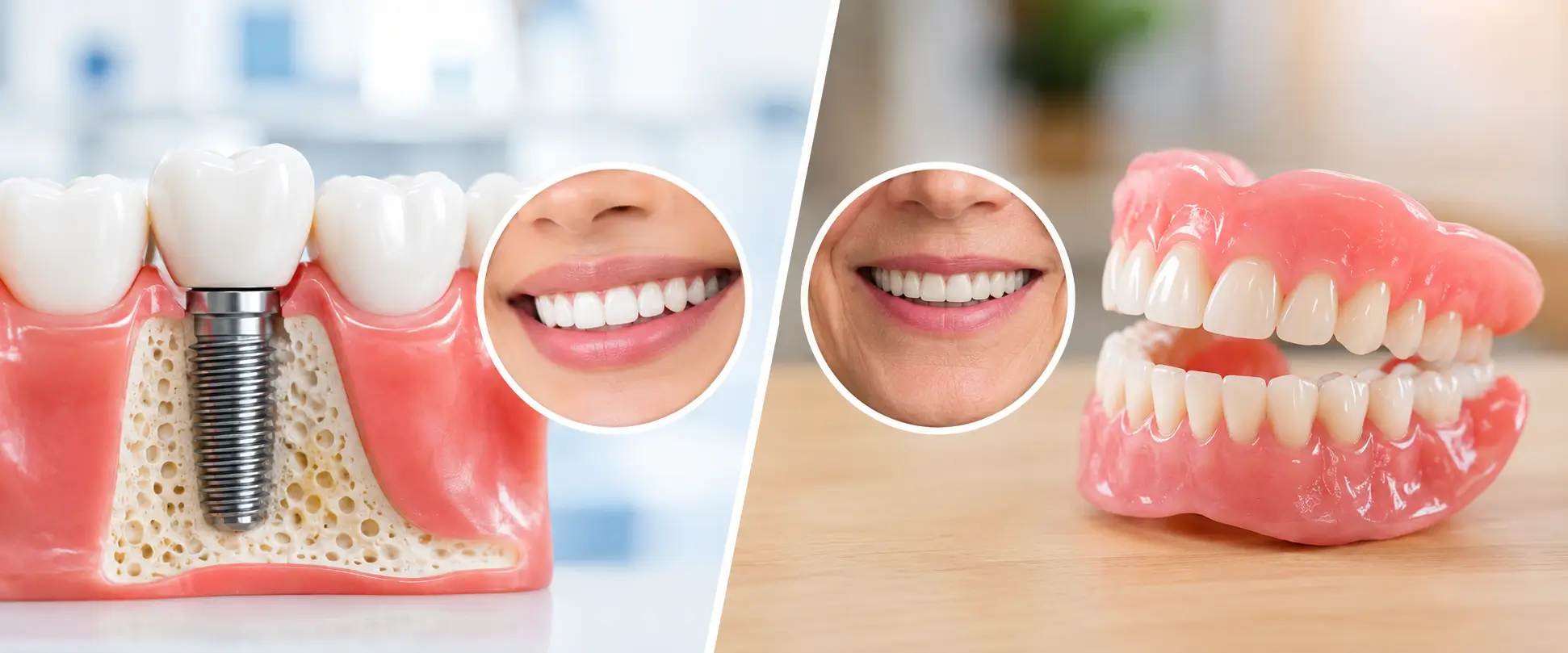
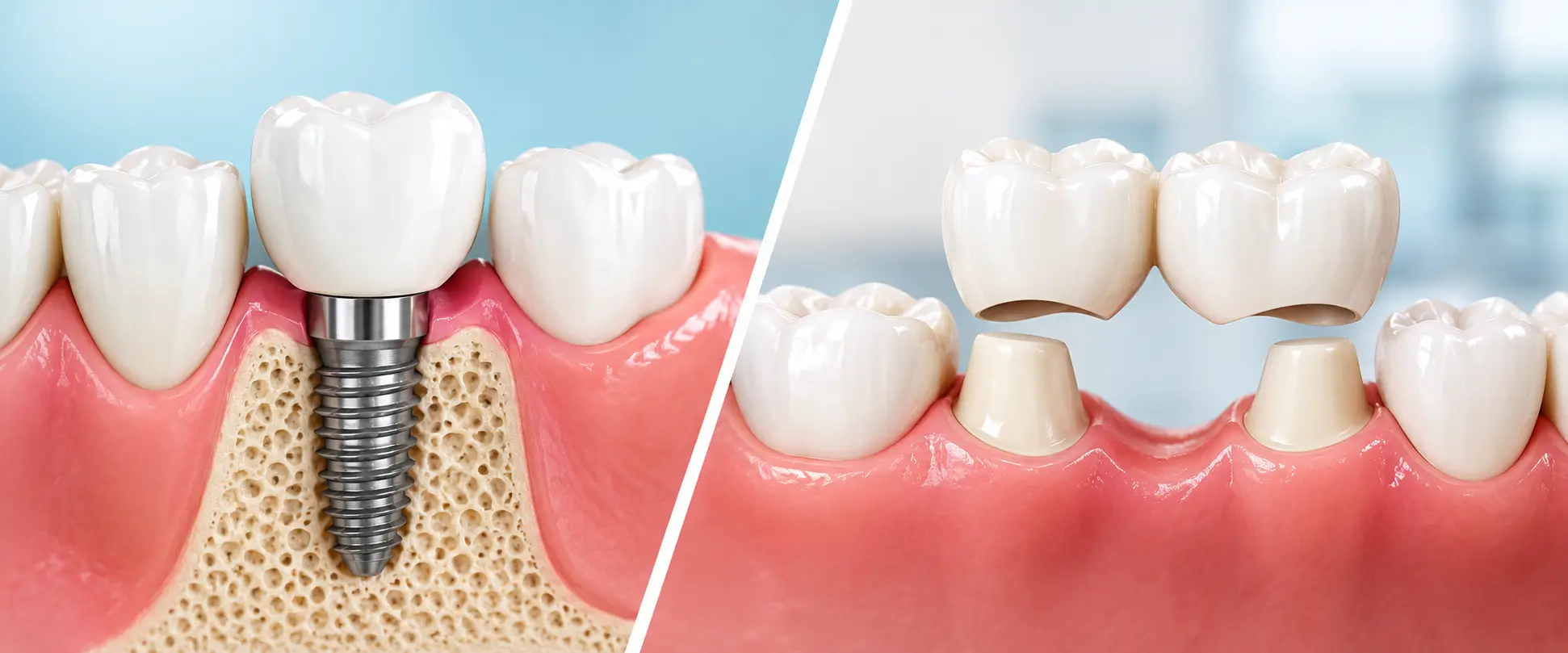
Dental implants are small, biocompatible fixtures, usually made of titanium, that are surgically placed into the jawbone to replace missing tooth roots. As the surrounding bone heals, it can integrate with the implant, creating a stable foundation for a replacement tooth.
Once the implant has healed sufficiently, a connector called an abutment and a custom-made dental crown can be fitted to restore the missing tooth.
Dental implants can be used for:
-
A single missing tooth: An implant-supported crown replaces the missing tooth without relying on neighbouring natural teeth for support.
-
Multiple missing teeth: Several implants can support individual crowns or a dental bridge.
-
Several consecutive missing teeth: An implant-supported bridge can replace multiple teeth using strategically positioned implants.
-
Complete tooth loss: Implant-supported restorations can replace an entire arch of missing teeth in suitable patients.
Advantages of Dental Implants
1. Preserve neighbouring natural teeth
For a single missing tooth, an implant-supported crown usually does not require the adjacent teeth to be reduced to support the restoration. This can be an important consideration when those teeth are otherwise healthy.
2. Provide stable chewing function
An implant is anchored in the jawbone and can provide a stable foundation for a replacement tooth. With appropriate planning and a well-designed crown, it can help restore comfortable chewing.
3. Support the jawbone around the implant
After a tooth is lost, the jawbone in that area may gradually shrink because it no longer receives stimulation from the tooth root. An implant transfers functional forces to the surrounding bone and may help limit bone loss locally. However, it does not prevent all changes in the jawbone.
4. Offer a natural-looking result
The replacement crown can be designed to match the colour, shape, and proportions of the surrounding teeth. The final appearance depends on the implant position, gum condition, restoration design, and individual healing.
5. Provide a long-term tooth replacement option
Dental implants can function for many years with appropriate case selection, treatment planning, oral hygiene, and regular professional maintenance. However, the implant and the crown have different maintenance requirements, and neither is guaranteed to last a lifetime.
Limitations of Dental Implants
Dental implants also have considerations that patients should understand before proceeding.
-
Implant placement requires a surgical procedure.
-
Treatment may take several months, depending on healing and whether additional procedures are needed.
-
Adequate bone volume and healthy or appropriately treated gums are important.
-
Bone grafting or other preparatory treatment may be required in some cases.
-
Smoking, uncontrolled medical conditions, active gum disease, and poor oral hygiene may affect suitability or healing.
-
The initial cost may be higher than that of a traditional bridge.
A clinical examination and appropriate diagnostic imaging help determine whether implant treatment is suitable for your situation.
What Is a Dental Bridge?
A dental bridge is a fixed restoration that replaces one or more missing teeth by using supporting teeth or dental implants.
In a traditional dental bridge, the teeth on either side of the gap are prepared to receive crowns. These crowns support an artificial tooth, known as a pontic, which fills the space left by the missing tooth.
There are several types of dental bridges:
-
Traditional bridge: Uses crowns placed on supporting teeth on either side of the gap.
-
Cantilever bridge: Uses support from one side of the gap and is suitable only in selected cases.
-
Maryland bridge: Uses a framework or wings bonded to the back of supporting teeth, often with less removal of natural tooth structure than a traditional bridge.
-
Implant-supported bridge: Uses dental implants rather than natural teeth as its primary support.
The appropriate type depends on the location of the missing tooth, the condition of the supporting teeth, bite forces, aesthetic requirements, and other clinical factors.
Advantages of Dental Bridges
1. Often a shorter treatment timeline
A traditional bridge can frequently be completed in fewer stages than implant treatment because it does not require implant placement and bone healing. The exact timeline depends on the condition of the teeth and gums and whether additional treatment is needed.
2. No implant surgery is required
A traditional bridge does not require surgery to place an implant. This may be useful for patients who prefer to avoid implant surgery or for whom implant treatment is not appropriate.
3. Restores appearance and chewing function
A well-designed bridge can fill the gap left by a missing tooth, improve the appearance of the smile, and help restore chewing function.
4. May be practical when neighbouring teeth already need crowns
If the teeth adjacent to the gap already have extensive restorations or require crowns for other clinical reasons, a traditional bridge may be a reasonable option. The dentist must assess whether these teeth can provide adequate support.
5. Can have a lower initial cost
A traditional bridge may cost less initially than an implant-supported crown in some cases. However, the total cost depends on the number of teeth involved, materials, supporting tooth condition, and any future maintenance or replacement.
Limitations of Dental Bridges
A traditional bridge has some important disadvantages.
-
Supporting teeth usually need to be reshaped to accommodate the crowns.
-
The missing tooth root is not replaced, so the underlying jawbone may continue to shrink.
-
Plaque and food debris can collect around and beneath the bridge, requiring careful cleaning.
-
The supporting teeth may develop decay, gum problems, or other complications if maintenance is inadequate.
-
If a supporting tooth develops a serious problem, the bridge may also be affected.
These considerations do not make bridges a poor choice. They highlight why the condition of the neighbouring teeth and the patient's ability to maintain the restoration are important parts of treatment planning.
Dental Implants vs Bridges: Key Differences
The following comparison outlines the main differences between a single implant-supported crown and a traditional dental bridge.
|
Comparison |
Dental Implants |
Traditional Dental Bridges |
|---|---|---|
|
How they are supported |
Anchored in the jawbone |
Usually supported by neighbouring teeth |
|
Replacement of tooth root |
Replaces the root functionally with an implant fixture |
Does not replace the missing tooth root |
|
Effect on adjacent teeth |
Usually does not require preparation of healthy neighbouring teeth |
Usually requires preparation of supporting teeth |
|
Surgical procedure |
Requires implant placement surgery |
Does not require implant surgery |
|
Jawbone changes |
May help limit bone loss around the implant |
Does not provide stimulation to the bone beneath the missing tooth |
|
Treatment time |
Often takes several months, depending on healing and case complexity |
Often completed in fewer stages |
|
Initial cost |
Often higher |
May be lower, depending on the case |
|
Cleaning and maintenance |
Requires careful cleaning around the implant and crown |
Requires careful cleaning around the supporting teeth and beneath the bridge |
|
Potential long-term concerns |
Implant-related complications, gum inflammation, and crown or component damage |
Decay or gum problems in supporting teeth, bridge damage, and loss of support |
|
Best suited to |
Patients with suitable oral health and sufficient bone, or those who can undergo any required preparatory treatment |
Patients with suitable supporting teeth and clinical conditions for a bridge |
The main difference is how each restoration is supported. An implant-supported crown replaces a single missing tooth without using adjacent natural teeth as supports. A traditional bridge relies on the neighbouring teeth, which makes their condition particularly important.
Dental Implants vs Bridges: Which Is Better for One Missing Tooth?
For a single missing tooth, both a dental implant and a traditional bridge may be suitable. The better option depends on your individual dental condition rather than the treatment alone.
When a Dental Implant May Be the Better Option
An implant may be worth considering when:
-
The neighbouring teeth are healthy and do not need crowns.
-
There is sufficient jawbone, or any necessary bone augmentation is feasible.
-
The gums are healthy or have been appropriately treated.
-
You want to replace the missing tooth without relying on adjacent natural teeth.
-
You are medically suitable for implant surgery.
-
You are comfortable with a potentially longer treatment process and the associated cost.
For example, if you have lost one tooth but the teeth on either side are healthy, an implant-supported crown may help preserve those teeth by avoiding the need to prepare them for a traditional bridge.
When a Dental Bridge May Be the Better Option
A traditional bridge may be worth considering when:
-
The adjacent teeth already require crowns or substantial restorative treatment.
-
You prefer to avoid implant surgery.
-
Implant placement is unsuitable or would involve additional procedures you do not wish to undergo.
-
You need a replacement within a shorter treatment timeline, where clinically feasible.
-
The supporting teeth and gums are healthy enough to support a bridge.
For example, if the teeth on either side of the gap already have extensive damage and require crowns, a bridge may address the missing tooth and the restorative needs of those supporting teeth at the same time.
These are examples, not fixed rules. Your dentist should assess the advantages and limitations of both options before recommending a treatment.
Dental Implants vs Bridges: Which Costs Less?
The cost of replacing a missing tooth varies according to the treatment selected, the number of teeth involved, the materials used, and the complexity of the case.
A traditional bridge may have a lower initial cost because it does not involve implant surgery. However, implant treatment and bridge treatment should be compared based on the complete treatment plan rather than the price of a single component.
What Affects the Cost of Dental Implants?
The overall implant treatment cost may include:
-
Initial consultation and clinical examination
-
Dental X-rays or 3D imaging, when indicated
-
Implant fixture and surgical placement
-
Abutment and final crown
-
Bone grafting or other preparatory procedures, if required
-
Temporary restorations, when needed
-
Follow-up appointments and maintenance
What Affects the Cost of a Dental Bridge?
The cost of a traditional bridge may depend on:
-
The number of teeth included in the bridge
-
The type of bridge and materials selected
-
The condition of the supporting teeth
-
Any root canal treatment or other procedures required
-
Laboratory fabrication and the complexity of the restoration
-
Follow-up care and future maintenance
When comparing treatment estimates, ask what is included, whether temporary teeth are required, and what additional procedures might affect the final amount.
It is also worth considering the longer-term maintenance requirements. Neither an implant nor a bridge is maintenance-free, and both may eventually need repair or replacement.
How Long Do Dental Implants and Bridges Last?
Both dental implants and bridges can provide long-term service, but their longevity depends on several factors, including oral hygiene, gum health, bite forces, material quality, smoking, and regular professional care.
Dental Implant Lifespan
A dental implant can remain functional for many years when it is appropriately placed and maintained. However, the implant fixture and the crown it supports are different components and may not have the same lifespan.
Complications can include inflammation around the implant, bone loss, loosening of components, or damage to the crown. Regular dental examinations help identify potential problems early.
Dental Bridge Lifespan
A dental bridge can also last for many years with good oral hygiene and appropriate follow-up. Its longevity depends not only on the bridge itself but also on the condition of the supporting teeth and gums.
Decay around supporting teeth, gum disease, damage to the restoration, or changes in the bite may affect how long the bridge remains functional.
Neither option can be guaranteed to last a lifetime. Your dentist can explain the expected maintenance needs and factors that may affect the longevity of your particular restoration.
Can You Get Dental Implants if You Have Low Jawbone Density?
Possibly. Having reduced jawbone volume does not automatically rule out dental implants, but it can make treatment planning more complex.
After tooth loss, the jawbone in that area may gradually shrink. The amount of available bone, its shape and density, the location of the missing tooth, and the surrounding anatomical structures all affect implant suitability.
Depending on the findings, treatment options may include:
-
Placing an implant if the available bone is adequate.
-
Bone grafting to increase the available bone volume.
-
Other bone augmentation procedures where clinically appropriate.
-
Considering a dental bridge or another tooth replacement option if implant treatment is unsuitable.
A dental examination and appropriate imaging, sometimes including a 3D CBCT scan, can help the dentist evaluate the available bone and plan treatment.
It is important to understand that bone grafting is not necessary for every patient with reduced bone volume, and not every patient with low bone density can be treated with implants. The decision depends on the individual clinical findings.
Who Is a Suitable Candidate for Dental Implants?
Dental implants may be considered for people who have one or more missing teeth and whose oral and general health allow the procedure.
Factors that may support implant treatment include:
-
Adequate jawbone volume or the possibility of appropriate bone augmentation.
-
Healthy or appropriately treated gums.
-
Good oral hygiene and a willingness to attend follow-up appointments.
-
Medical conditions that are sufficiently controlled for surgery.
-
Realistic expectations about treatment time, cost, and maintenance.
Certain medical conditions, medications, smoking habits, and a history of gum disease may affect treatment planning or healing. These factors need individual assessment rather than an automatic decision for or against implants.
Who Is a Suitable Candidate for a Dental Bridge?
A traditional bridge may be appropriate for someone who has missing teeth and suitable supporting teeth on either side of the gap.
Your dentist will consider:
-
The strength and condition of the supporting teeth.
-
The health of the gums and surrounding bone.
-
The position and number of missing teeth.
-
The forces created by your bite.
-
Your oral hygiene and ability to clean beneath the bridge.
-
Your treatment preferences and budget.
If the supporting teeth are weak, mobile, or affected by significant decay or gum disease, they may not be suitable for supporting a bridge without additional treatment.
A bridge is therefore not automatically the easier option for every patient. Its success depends on selecting an appropriate design and ensuring that the supporting teeth can withstand the demands placed on them.
Can Dental Implants and Bridges Be Combined?
Yes. Dental implants can be used to support a bridge when several adjacent teeth are missing.
Instead of placing an individual implant for every missing tooth, a dentist may position implants strategically to support a single connected restoration. This is known as an implant-supported bridge.
For suitable patients, this approach can replace several missing teeth while reducing the number of implants required compared with replacing every tooth individually.
The number and position of implants depend on the length of the gap, bone availability, bite forces, restoration design, and other clinical factors. An implant-supported bridge is different from a traditional bridge because its primary support comes from implants rather than natural teeth.
What Should You Ask Your Dentist Before Choosing?
Before deciding between a dental implant and a bridge, ask your dentist the following questions:
-
Which option is suitable for my specific dental condition? Ask about the findings from your examination and why one treatment may be more appropriate than the other.
-
What is the condition of my neighbouring teeth? Find out whether they are healthy or already need restorative treatment.
-
Do I have enough jawbone for an implant? Ask whether additional imaging or bone grafting may be necessary.
-
How long will the treatment take? Request an estimated timeline, including healing and the placement of the final restoration.
-
What will the complete treatment cost? Ask for an itemised estimate covering the procedures, materials, temporary restorations, and follow-up care.
-
What are the risks and limitations? Make sure you understand the possible complications and the alternatives available.
-
How will I need to maintain the restoration? Ask how to clean it properly and how frequently professional reviews are recommended.
These questions can help you understand not only how the missing tooth will be replaced but also what the treatment will involve over time.
Tooth Replacement with Studio Dentale
At Studio Dentale, we encourage patients to make treatment decisions based on their individual dental needs, clinical findings, and long-term oral health goals.
During a consultation, the dentist can assess the missing tooth, examine the surrounding teeth and gums, evaluate the bite, and determine whether additional imaging is needed. Based on these findings, the available options can be discussed along with their benefits, limitations, expected treatment time, costs, and maintenance requirements.
If you are considering dental implants, the consultation should also address the condition of the jawbone and whether any preparatory procedures may be needed. If a dental bridge is being considered, the health and strength of the supporting teeth are especially important.
Our aim is to help you understand your options clearly so that you can make an informed decision with your dentist.
If you have a missing tooth and are considering dental implants or a dental bridge, you can book a consultation at Studio Dentale at our Kathmandu or Lalitpur location, whichever is more convenient for you. We welcome patients from across Nepal and around the world who want to explore suitable options for replacing missing teeth.
Frequently Asked Questions
Are dental implants better than bridges?
Dental implants may be preferable when the neighbouring teeth are healthy and suitable for implant treatment. Bridges may be more practical when the adjacent teeth already need crowns, implant surgery is unsuitable, or a shorter treatment timeline is important. The best option depends on your individual dental condition.
Is a dental implant more painful than a bridge?
Implant placement involves surgery, but local anaesthesia is used to help manage discomfort during the procedure. Some soreness or swelling may occur during recovery. A traditional bridge does not involve implant surgery, although preparing supporting teeth can also cause temporary sensitivity or discomfort. Your dentist can explain what to expect with either treatment.
Can a dental bridge be placed immediately after tooth extraction?
In some cases, a temporary or definitive bridge may be placed soon after an extraction, but this is not suitable for every patient. The timing depends on the condition of the supporting teeth, the healing tissues, and the type of bridge being planned.
Does a dental implant prevent bone loss completely?
No. An implant can help maintain bone around the implant by transferring functional forces to the surrounding bone, but it does not prevent all bone changes after tooth loss. Bone health also depends on factors such as gum health, implant position, healing, and maintenance.
Can I get a dental implant if my neighbouring teeth are damaged?
Possibly. The condition of neighbouring teeth does not automatically rule out an implant, but those teeth may need treatment before or alongside implant placement. Your dentist will assess whether the teeth, gums, and available bone can support the proposed treatment.
Which option is better if I need to replace several missing teeth?
Both traditional bridges and implant-supported restorations can replace several missing teeth in suitable cases. The decision depends on the number and location of the gaps, the condition of the supporting teeth, available bone, bite forces, and treatment preferences.
Is a dental bridge easier to maintain than an implant?
Neither option is maintenance-free. Implants require careful cleaning around the implant and crown, while bridges require cleaning beneath the artificial tooth and around the supporting teeth. Your dentist can recommend appropriate cleaning tools and a follow-up schedule for your restoration.
What if I cannot afford a dental implant?
A traditional bridge may be an alternative, depending on the condition of your neighbouring teeth and other clinical factors. Your dentist can compare the available options and explain the full cost of each treatment. It is important to choose a restoration that is clinically suitable rather than making the decision based on initial cost alone.
Final Thoughts
Dental implants and dental bridges can both help restore a missing tooth, but they work differently and have different treatment requirements.
An implant replaces the missing tooth root and supports a crown or bridge, while a traditional bridge uses neighbouring teeth for support. Implants may be particularly worth considering when adjacent teeth are healthy, whereas bridges may be practical when the supporting teeth already require crowns or implant surgery is not suitable.
The right choice depends on your oral health, jawbone condition, supporting teeth, treatment timeline, budget, and long-term maintenance needs.
If you are unsure which option is appropriate, a dental consultation can help you compare the alternatives and understand the likely benefits, limitations, and costs before proceeding with treatment.
At Studio Dentale, our team can help you explore suitable tooth replacement options based on your individual dental needs and clinical assessment.
Kathmandu: +977-4532180 / 4532181
Lalitpur: +977-9801119282